
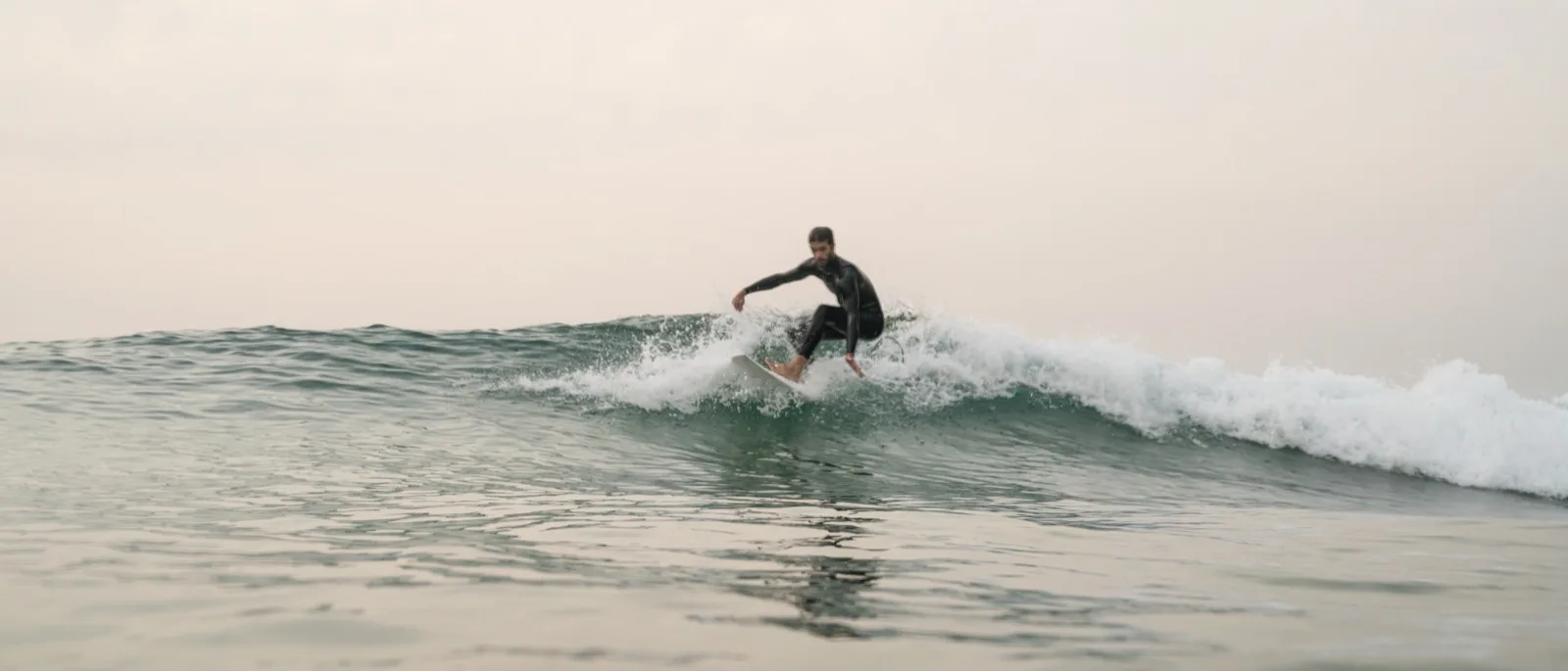
Why do I keep surfing at the same level, no matter how much I surf? If you’re somewhere in the intermediate zone, you’ve probably asked it. You’re getting waves, you can do a bottom turn and a top turn, but it’s been a while since anything really moved, and more sessions don’t seem to change it.
Here’s the honest answer, and it surprises most people. Surfing more, on its own, rarely moves it. What’s going on is that somewhere along the way you turned a slightly wrong movement into a habit, and every session you paddle out, you practise that same wrong movement again. The more you repeat it, the more it feels right. That’s what a plateau actually is: a pattern grooved so deep it has gone invisible to you.
Let me give you the most common one I see. On the bottom turn, most intermediate surfers push off the back foot and lean, instead of rotating the torso. So the board climbs sideways up the wave, the front rail catches, and they never unlock the top of the turn. They’ve been doing it so long they confuse pumping with bottom turning. It feels like surfing. It even works, sort of. But it’s the exact thing keeping them stuck, and repeating it just sets it deeper.
The correct movement is counterintuitive, which is why almost no one figures it out on their own. Rotating the shoulders and swinging the arm back through the turn has to be much bigger than feels necessary. You think you’re doing it. You’re not, not even close. When I coach someone through it, the first time they actually rotate as much as they need to, it feels like too much to them. That feeling is the tell that they were nowhere near it before.
Here’s the part that matters most. You can’t feel the gap from the inside. Your brain thinks the movement you’re doing is the movement you see the pros doing, because from in there it feels the same. That’s why surfing more, on its own, tends to reinforce the plateau instead of breaking it. You have to actually see where your pattern and the right pattern split apart. On a video analysis call that’s the whole point: we put your wave next to a pro’s, frame by frame, and the gap you couldn’t feel becomes something you can’t unsee.
Once you can see it, breaking the habit is its own skill. Instead of grinding the same session harder, you isolate one thing and practise it on its own, on the skate, on land, in the wave pool where the takeoff is already handled, so you get the reps you’d never get in the ocean. One of the guys I coach, Ricardo, said it well after we worked together:
“Focusing on one thing first, getting it done properly before moving to the next. It makes the learning more efficient… instead of aiming for everything and getting zero done properly.”
That’s it. One wrong pattern at a time, replaced properly, before you move on.
It’s like getting fitter. You build a six-pack over weeks of consistent, focused reps, and surfing is the same. The new pattern comes from grooving it again and again until it holds at speed, where you don’t have time to think. I can show you exactly what to change, the same way someone can show you how to hit a tennis ball, but you’re the one who has to go and put it in the court.
The bottom turn is one example. If you want the wider map of what can cap your surfing, from mindset to reading the wave, I put that together in Why Most Surfers Plateau.
So if you’ve been stuck at the same level for a while, start by seeing what you can’t feel. That is the part that actually breaks a plateau. The quiz we built is the first step: it asks what you’re already noticing in your own surfing and points you to the one thing that’s holding the rest back, so you know where to look first.
It only takes a few minutes: